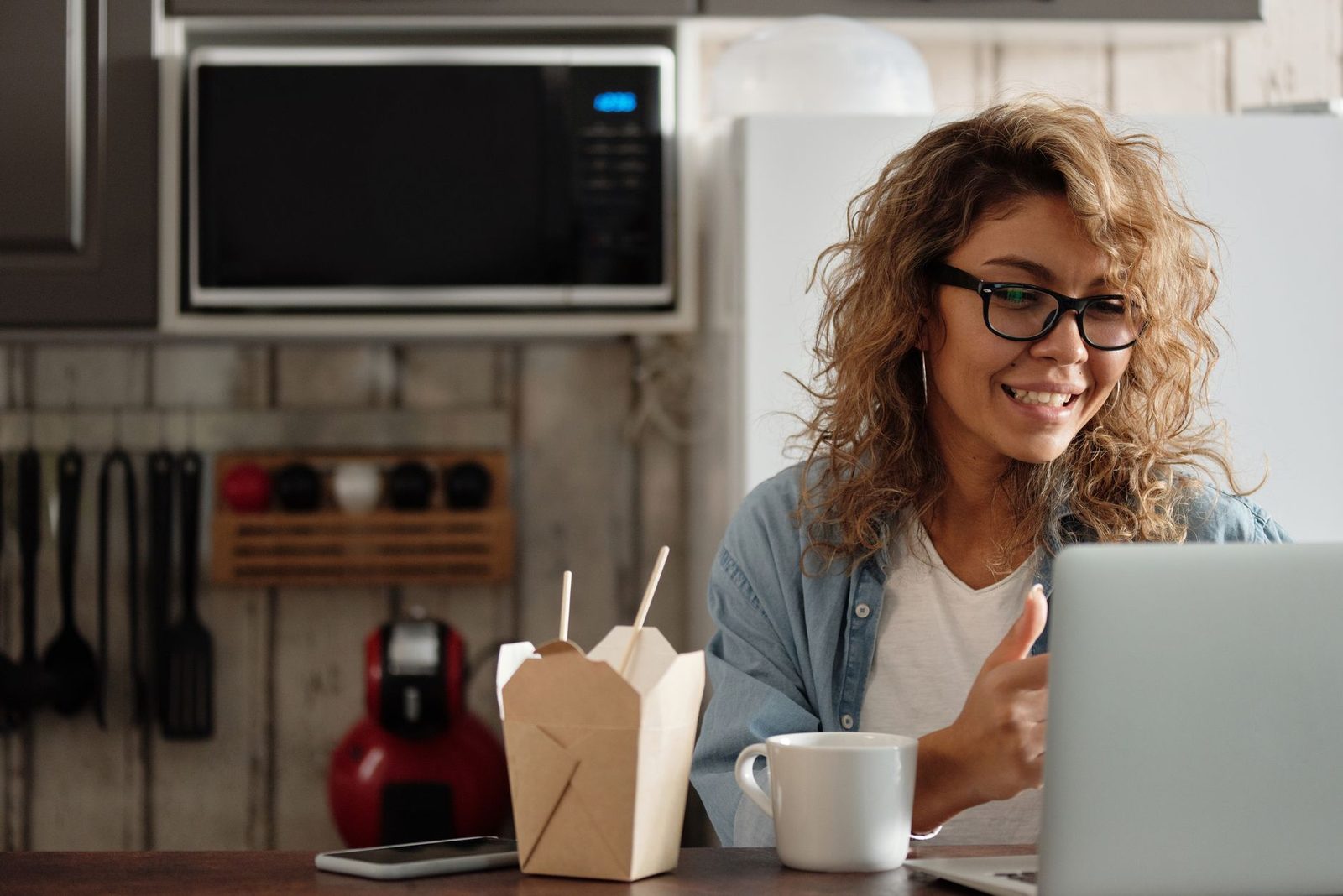
There's one backdrop that holds a stranger's attention on a chatroulette site more reliably than a handsome face or a carefully rehearsed opener: a cutting board, a pan heating up, a mug giving off steam. Not because it looks good. Because it feels real.
Regulars notice it fast. Someone sitting in front of a blank white wall has to produce something — a line, a smile, a reason to exist in the frame — in the three seconds before the click. Someone slicing an onion has nothing to produce at all. They're already busy, and that busyness becomes a conversation starter all by itself.
This article isn't just for cooks. It explains why eating or cooking in front of a stranger defuses the "next" reflex, what to prepare when a conversation runs twelve minutes, how to set up framing and sound in a noisy kitchen, and where the line falls between a warm invitation and a filmed dinner nobody asked for.
Why a meal suspends the urge to click
Commensality is a social protocol as old as our species
Anthropologists use the word commensality for the act of eating together. It's not some quaint detail: it's one of the very few universal human behaviours, present in every documented society. Eating side by side signals, without anyone needing to say it, that the other person isn't a threat.
Evolutionary psychologist Robin Dunbar, at the University of Oxford, published a study on shared meals in the UK in Adaptive Human Behavior and Physiology in 2017: people who ate in company more often reported higher life satisfaction, a denser friendship network and a stronger sense of local belonging. Dunbar sees a mechanism comparable to social grooming among primates — an activity that, in itself, serves "no purpose", but that builds bonds precisely because it fills time together.
Random video chat suffers from exactly the opposite problem: two strangers find themselves face to face with no shared activity. All that's left is pure conversation, immediately, with no warm-up. It's the most demanding configuration imaginable, and it's why so many people give up after twenty "nexts". Putting food back in the frame means putting the missing activity back in.
Shared attentional focus, once again
Like drawing or playing an instrument, cooking creates what researchers call a shared attentional focus: a third element both pairs of eyes can settle on, which takes the pressure off the face-to-face.
Three seconds spent watching a pan are three seconds where nobody has to hold the other's gaze or fill the silence. For a shy person, that's an enormous relief. The frame becomes a work surface, not a mirror.
Food is the most universal subject on earth
On an international chatroulette, the barrier isn't just language: it's the shared frame of reference. A French joke doesn't travel. A film doesn't always travel. A dish does.
Show a crêpe batter to a stranger in Brazil, Poland or Vietnam: in all three cases, they know what it is, they have a local version to tell you about, and they want to tell you about it.
It's one of the rare subjects that spontaneously produces a reciprocal question. And the reciprocal question is the basic building block of any conversation that lasts longer than a minute.
What it actually changes about the "next" rate
No platform publishes usable statistics, and you should be wary of the numbers floating around on forums. But the mechanism is observable, and almost everyone who has tried it describes it the same way:
| Situation | Typical reaction from the stranger |
|---|---|
| Sitting in front of a wall, motionless | Sized up in 2 seconds, frequent next |
| Cup of tea in hand | Micro-pause, sometimes a hello |
| Cutting board in active use | Almost guaranteed question: "what are you making?" |
| Dish coming out of the oven, visible steam | Immediate verbal reaction, often enthusiastic |
What matters isn't the food itself, it's legible movement. A gesture whose intention is clear without sound, in a fraction of a second, in a sometimes heavily compressed thumbnail. Slicing, pouring, flipping a pancake: all of it reads instantly. Reading a book doesn't — the image is too static.
How to do it without turning your kitchen into a TV set
Pick the right time window
A random video chat conversation rarely lasts more than ten to fifteen minutes. Starting a beef bourguignon makes no sense: you'll be interrupted twenty times, and nobody will ever see the result.
The preparations that work share three traits: short, visual, interruptible.
- Batters for the pan: crêpes, pancakes, blinis. The flip is a mini-spectacle, it's understood everywhere, and it needs no explanation.
- Slowly brewed coffee or tea: a French press, a glass teapot, a pour-over. The gesture is calm and the ritual is recognisable the world over.
- Colourful chopping: peppers, citrus, herbs. The colour contrast survives even a compressed image.
- Assembly jobs: bruschetta, open sandwiches, rice bowls. Every step is short, every interruption is painless.
What fails: anything that requires leaving the frame, anything that produces thick smoke, and anything that forces you to look down for more than ten seconds at a stretch.
Framing: the countertop, not the face
This is the counterintuitive part. In a standard video call, you centre the face. Here, you pull back and tilt slightly downward to show your hands and the work surface. The face takes the upper third, the food the lower third.
On a laptop sitting flat on a counter, the built-in webcam usually points at the ceiling and gives a disastrous angle. Two simple fixes: prop the machine up on a thick book, or use an adjustable tilting laptop stand that solves the problem once and for all and frees up counter space.
If you cook often, an external webcam on a stand is a complete game-changer: you set it down next to the board at shoulder height and stop contorting yourself to stay in frame.
Light: the kitchen is a trap
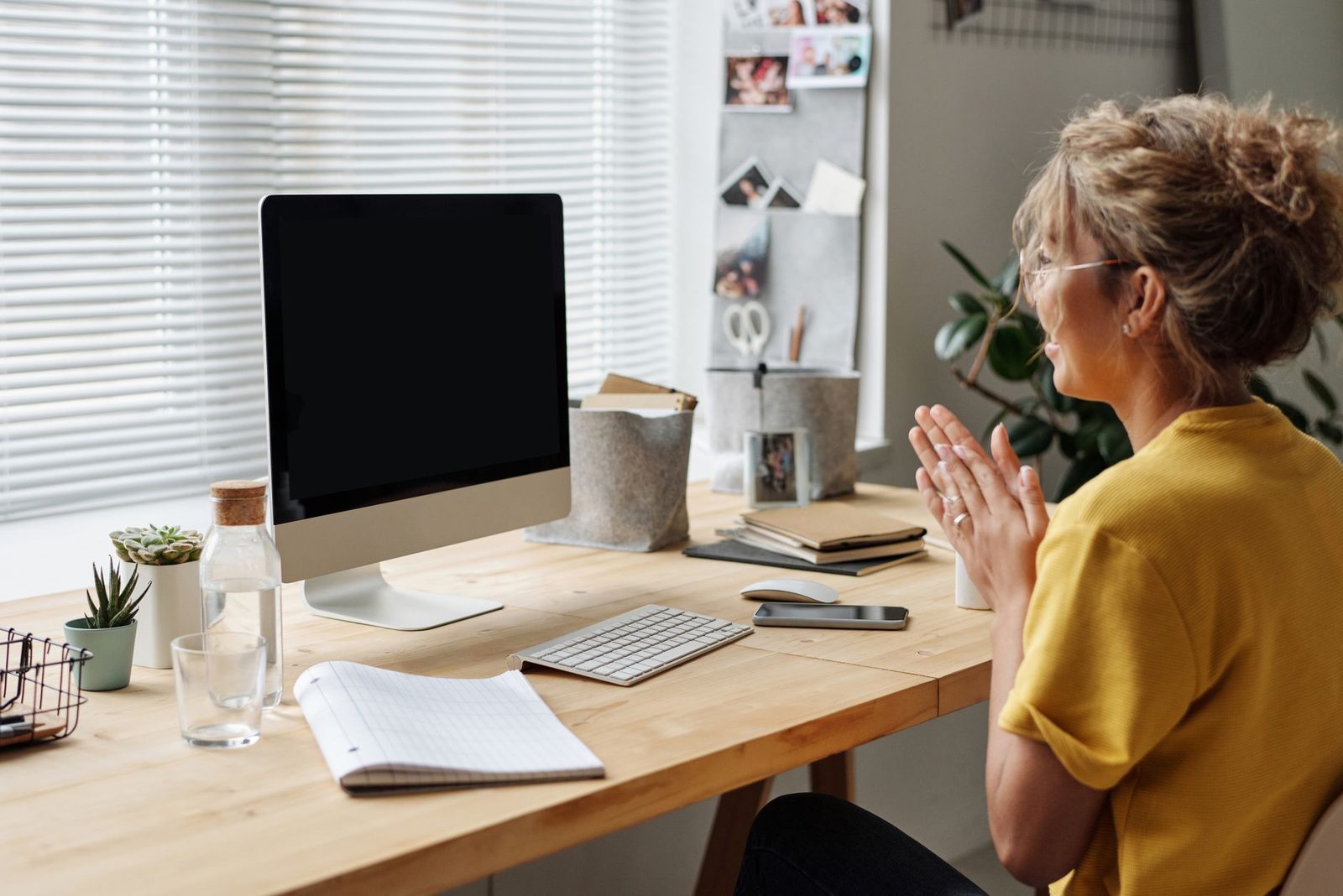
Kitchens often combine the worst of everything: a cold overhead light above your head that hollows out your eyes, and a window behind you that turns your face into a black silhouette.
Three rules are enough:
- Never put the window behind you. Turn the work surface or the computer a quarter turn.
- Switch off the direct ceiling light if it's the only source, and favour a side light at face height.
- Add a raking light on the work surface if you're cooking in the evening: a small dimmable LED lamp placed beside the board is enough to make the colours of the food readable.
The goal isn't to look good. The goal is for the stranger to understand the image in one second. An unreadable image gets nexted just as fast as an empty one.
Sound: the real problem
An extractor hood, a sizzling pan and a laptop's built-in microphone make for a catastrophic cocktail. Laptop mics are omnidirectional: they pick up everything, compress everything, and your voice ends up buried under white noise.
Two fixes, in order of effectiveness:
- Turn off the extractor hood while you're talking. Free, and it solves 80% of the problem.
- Switch to a noise-cancelling headset or a cardioid USB mic placed in front of you: it only listens to what's coming from the front and ignores a good chunk of the kitchen background.
If there's only one thing you invest in for video chat in general, make it sound. A mediocre image with clear audio sustains a conversation; a beautiful image with dirty audio kills it in thirty seconds.
The conversations it actually triggers
The most common pattern: "and where you are?"
In nearly every case, the stranger picks up by talking about their own cooking. They describe a dish from their region, sometimes get up to fetch an ingredient, hold up a bottle, a jar of spices, a utensil you've never seen before.
That's where the shift happens: the conversation is no longer "two strangers staring at each other", it becomes "two people showing each other something". The power dynamic vanishes, and the question of being physically judged fades into the background.
The "teach me" pattern
The second scenario is even more productive. The stranger asks how you do it, or offers to recreate something. Some come back the next day with the result.
For anyone drawn to this format, keeping a blank recipe journal within reach is no gimmick: noting down the dish, the country and the first name turns a string of fleeting conversations into a real collection. It's also, incidentally, the best way not to forget a Turkish recipe explained at 11 p.m. in shaky English.
The language pattern
Food names are the easiest vocabulary to trade between languages. They're concrete, they can be shown, and a mispronunciation carries no consequences. Plenty of language learners use video chat explicitly for this, with a small pocket phrasebook open beside the keyboard for the moments they get stuck.
The limits: where it gets tiresome
Any staged setup can backfire. Three pitfalls to know about.
The chef's monologue
If you explain your recipe for eight minutes without asking a single question, you've replaced a conversation with a TV show. The stranger watches politely, then leaves. The rule is simple: ask the other person a question every thirty to forty seconds. Cooking is a backdrop, not content.
The camera that no longer shows anyone
Some people end up framing nothing but the pan. The face disappears, and the conversation becomes a voice-over. Yet video chat draws all its value from the face — that's exactly what sets it apart from a forum. Keep yourself in frame.
The meal as forced intimacy
Eating in front of someone is an intimate act. It can make people uncomfortable, especially if the framing is very tight on your mouth or if the person opposite hasn't eaten in a long while. Simple signal: if the other person looks away or cuts their camera, move the plate out of the frame.
And an obvious point that's too often forgotten: you don't propose "having dinner together" to a stranger you met forty seconds ago. It sounds charming, but it's almost always read as a come-on. Let the food stay a backdrop. If the other person turns it into a date, that will be their idea, not yours.
Safety: what your kitchen says about you
A kitchen is talkative. It often holds more identifying clues than a living room:
- Mail left on the counter — name, address, sometimes a reference number.
- Supermarket labels and regional brand bags, which pin you down to the city.
- A school calendar, a prescription, a bill stuck to the fridge with magnets.
- Power sockets and light switches, whose shape gives away the country.
- Sound: church bells, the call to prayer, station announcements, distinctive sirens.
A quick sweep of the countertop before you connect solves 90% of the problem. As for the rest, France's data protection authority, the CNIL, regularly points out that still images pulled from a video stream circulate easily and stick around: assume that anything entering the frame can be captured.
Worth recalling the legal framework too: in France, recording or distributing someone's image without their consent is punishable under articles 226-1 and 226-2 of the Criminal Code. That applies to you just as much as to the stranger opposite.
A five-line instruction manual
- Choose something that takes under fifteen minutes, looks good and can be interrupted.
- Frame your face plus your hands, never the pan alone.
- Turn off the extractor hood, get the sound right before the picture.
- Ask the other person a question every thirty seconds.
- Clear the countertop of anything with your name on it.
The rest takes care of itself. That's actually the most interesting feature of this method: it demands no charisma, no quick wit, no attractive physique. It just demands that you be in the middle of doing something recognisable when someone stumbles across you by chance.
On a medium that rests entirely on the first second, that's probably the most underrated advantage there is. And unlike most video chat tricks, this one comes with a guaranteed side benefit: by the end of the session, you've had dinner.